Managing metadata upstream: Challenges and strategies for content producers
Rebecca Twardy in a NAB Show New York tech chat with Matt Foster, EVP Digital Transformation at Fremantle.
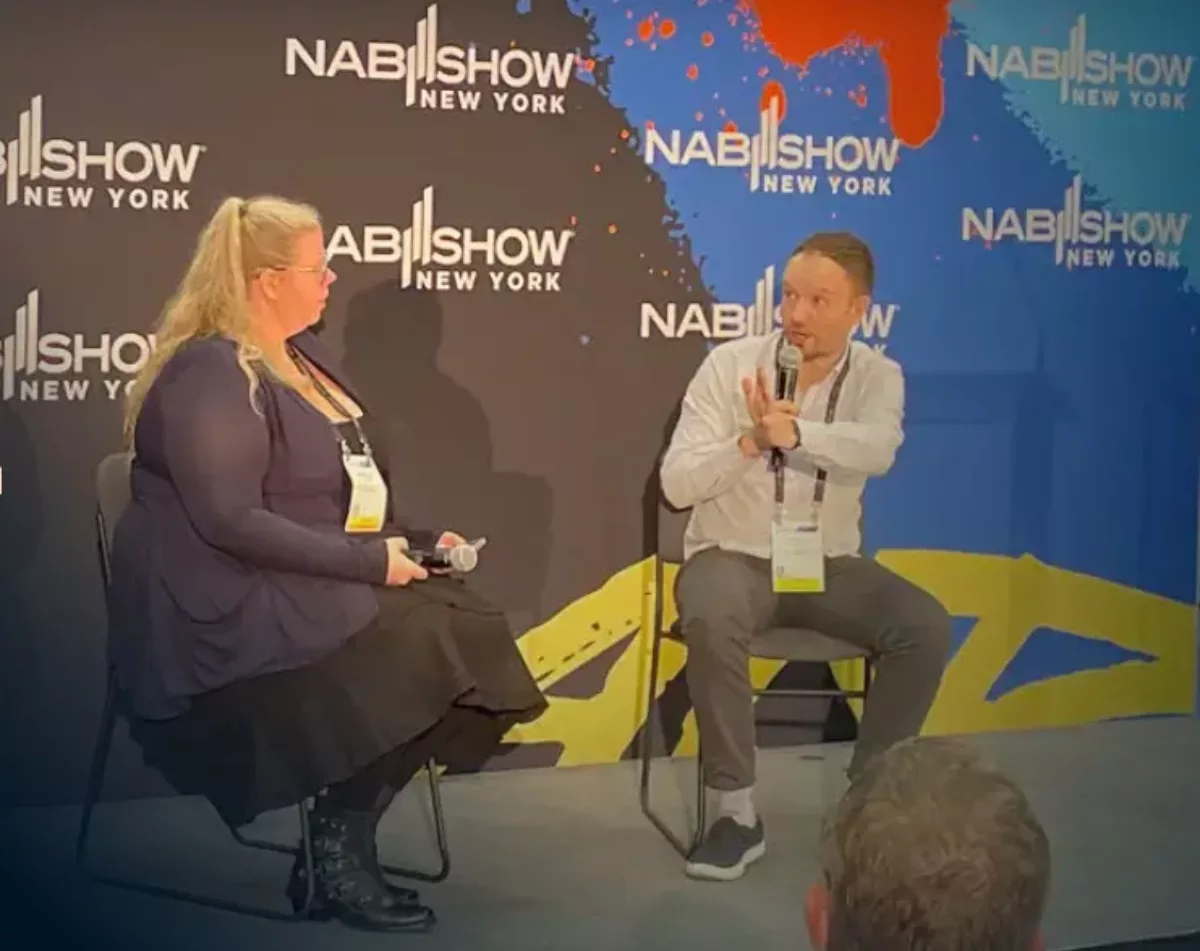
A NABShow New York tech chat with Rebecca Twardy (MEDIAGENIX) and Matt Foster (Fremantle)
On 25 October 2023, Rebecca Twardy, Strategic Account Director at MEDIAGENIX, took the stage at NABShow New York to interview Matt Foster, EVP Digital Transformation at Fremantle, on the challenges of title management, particularly upstream in content production.
Fremantle is one of the world’s largest TV and film production companies behind shows such as American Idol, The Young Pope, Too Hot to Handle and Mosquito Coast. Matt Foster’s role is to use technology to create a single view of Fremantle’s 38 global production companies in about 25 markets, from pitch to distribution, and to prepare for the next wave of AI.
The primary challenge, as Matt Foster explains, is that most metadata discussions revolve around distribution, where a broadcaster already publishes content, and various external sources provide readily available metadata. The true challenge, he says, lies in the early stages of content creation when a concept is just greenlit or in pre-production. At that point, no third-party sources offer metadata, and content producers must originate their metadata, which may differ from consumer-facing metadata.
Back to the source
Matt Foster highlights the need to determine when to capture titles and metadata during the production lifecycle.
One of the key principles is to go to the source, to the production teams. While early metadata may be minimal, content producers gradually gather more information as the production process advances.
However, managing metadata across multiple production companies in various markets becomes a significant challenge, requiring standardized metadata structures, genre lists, and minimum viable metadata records. This approach necessitates a change management effort and clear communication to ensure that all stakeholders align on metadata requirements.
Matt Foster suggests identifying crucial moments in the content lifecycle for capturing metadata. Green-light and content delivery serve as two fundamental moments.
The challenge lies in identifying the intervals between these pivotal moments, which can vary significantly depending on the type of content being produced. For instance, a movie might have years between these moments, while a daily soap could generate new episodes daily. The industry is still grappling with the best approach for capturing metadata during these interim stages.
Metadata for analytics
Rebecca Twardy’s talk with Matt Foster also sheds light on the importance of metadata in analytics. Matt emphasizes the significance of genre, budgets, trends, territories, cast and crew information, episode durations, time slots for broadcast, and episode synopses.
Understanding how many scripted high-end drama or game shows are being created, how these vary over time, and the budgets allocated for these productions is essential for strategic decision-making. Additionally, keeping a close eye on the territories where content is being produced and whether this is trending upwards or downwards is crucial for a comprehensive understanding of the content landscape.
For larger production companies like Fremantle, the complexity of metadata management is compounded by the need to aggregate data from various sources. Data is often scattered across different teams and platforms.
One of the primary challenges lies in having one source of truth for all the metadata associated with content.
According to Matt Foster, one of the primary challenges lies in having one source of truth for all the metadata associated with content. Without this centralized repository, performing even basic analytics can become laborious and time-consuming. For instance, answering questions about the number of shows currently in production or the total hours of content produced in the previous year becomes a daunting task without a unified metadata system.
Another challenge content producers face is determining when to capture marketing-approved metadata. Producers often have access to preliminary data that may not be used in the final distribution. In contrast, the distribution team may need to create or modify metadata as part of the marketing process. As a result, content producers are exploring ways to manage original and marketing-approved metadata separately, potentially through status tracking within the catalogue.
The transition to a centralized metadata management approach with standardized practices involves change management. This hurdle must be addressed to ensure a smooth transition to an improved metadata management system.
Insights
Get inspired
08 Oct. 2026
Mediagenix Context-Aware Scheduling Helps Media Companies Anticipate What Will Compete for Audience Attention


09 Sep. 2026
Mediagenix Curation Unlocks Greater Catalog Value Through Personalized Audience Experiences

08 Sep. 2026
Mediagenix Personalization Curates Sports Content Around Individual Viewer Interests.