Beyond Streaming: 2026 and the Shift to an Audience-Centric, Digital-First Content Supply Chain
Is your media supply chain ready for 2026? Move beyond static scheduling to a real-time, data-driven ecosystem. Learn how to break down silos and build a digital backbone that intelligently connects content to audiences across every platform.

An opinion from Fabrice Maquignon, Mediagenix’s CEO.
By 2026, media companies won’t be judged by how many platforms they publish to, but by how intelligently their supply chain matches content to audiences, in real time, across every endpoint, and over the full lifetime of the asset.
Right now, there’s a gap. That gap shows up when teams plan, schedule, and distribute content without real-time visibility into how audiences actually discover, engage with, or drop off from content.
Audience engagement has multiple drivers, including (but not limited to) mobile-first consumption, algorithmic discovery, and new value exchanges like pay-to-skip ads. But the content supply chain that serves those audiences is still largely an analogue mindset wrapped in digital tools. In practice, this often means static schedules, spreadsheet-led planning, and post-hoc performance reporting housed inside modern systems.
At the 2025 DPP Leaders Briefing, one shift was impossible to ignore: 2023 and 2024 were about automation and efficiency. 2025 was about using data to actually run the business.
We need to move away from automating the analogue. The next step is clear: inject data that connects audience signals upstream, so stakeholders can make operational decisions that result in better audience experiences. That means decisions about commissioning, windowing, promotion, and placement are informed by real audience behavior, not assumptions locked in months earlier.
This is an audience-centric content supply chain, and it’s where Mediagenix is betting its future.
The Audience Has Moved, But the Supply Chain Hasn’t
Right now, there’s a tension: Audience behaviour has evolved. Content infrastructure has not.
Younger audiences haven’t quite abandoned linear, but it’s no longer their starting point. If they show up to a live broadcast, it’s usually because digital brought them there via social buzz, recommendations, or “you have to see this” moments. Their daily viewing is fragmented across YouTube, TikTok, FAST channels, OTT apps, BVOD, social video, etc., and driven largely by algorithms, signals, and metadata. This hybrid experience is set to become the default content discovery journey. Rather than it being bad news, it actually presents a huge opportunity for media operations. However, most content operations are still built for a world where you plan a season, build a linear schedule, and deliver to multiple endpoints.
The model doesn’t scale to meet the complexity of audience engagement. Why? Because organizations are missing rich metadata to action data. They don’t have the data infrastructure to understand lifetime value, viewing patterns, or the true “effective catalog size” (the portion of the catalog that actually finds an audience). They can’t easily see, in one place, how rights, scheduling, and audience behaviour interact in real time. In many cases, teams can’t see in one place how rights, scheduling, and audience behaviour interact in real time.
Our industry is about storytelling, yet the fundamental data that can power the success of the media business is messy and without a narrative.
Why Traditional Broadcast Models Fail in Digital Markets
“We still ship the org chart.” Systems, workflows, and data structures often mirror how vendors are organised, not how audiences actually discover and consume content. Content is packaged and delivered based on internal ownership boundaries, not audience journeys.
The symptoms are everywhere:
- Siloed systems for metadata, rights, planning, and distribution.
- Manual stitching between tools and teams, adding delays and cost, often relying on Excel-driven processes that sit with a few critical individuals.
- Organizational blockers that make experimentation risky and slow.
- Scattered data that makes true personalization or targeted experiences nearly impossible.
We can’t hang the slow evolution of the industry on its “creative”. Other creative industries have already made the leap. Look at fashion. No one would argue that it’s not a creative business. Yet its supply chain is:
- Highly data-driven, continuously sensing street trends, social signals, and sales data.
- Capable of translating niche, early signals into mass-market retail collections at speed.
- Managed with intense focus on turns, margins, and lifecycle value.
For the fashion industry, data sits on top of a massive transactional backbone and that data is used to drive almost every decision.
By contrast, media, with a few exceptions like Netflix and Tubi, is still surprisingly light on true data mining. Catalog size is often treated as a bragging right, when in reality:
Catalog size doesn’t win. Effective catalog size does with the portion of the catalog that is exposed, discovered, and actually viewed.
The winners sweat the assets they already own, understand what combinations work for which audiences, and deliberately shape the future slate to match. That can mean re-windowing existing titles, reshaping FAST lineups, or doubling down on formats with long-tail engagement.
If audience engagement and content lifetime value are so critical, the question begs: Why aren’t we using more data to make intelligent decisions about both?
The 2026 Pivot: From Channel-Centric to Audience-Centric Operations
At DPP 2025, media leaders converged on similar themes: digital-first is about reimagining operations.
At Mediagenix, we like to use two analogies that help crystallize what needs to change.
The Museum: Smart Curation Across the Journey
Think of a great museum:
- There’s strategic curation of the collection: what to acquire, what to feature, how to balance blockbusters with hidden gems.
- There’s operational curation in the building: how exhibits flow, what visitors see first, and how signage and lighting guide attention.
- There are micro-experiences in the shop, in special exhibits, and now even in digital experiences and membership models.
Smart museums progressively curate the experience, from masterplan to individual visitor path. An audience-centric media operation works the same way:
- Strategists use data to decide what to commission or acquire.
- Planners and schedulers use data to decide when and how to expose it.
- Recommendation engines, promos, and social teams use data to decide who should see what next.
That’s smart curation along the whole lifecycle.
The Beehive: Parallel Work, Shared Intelligence
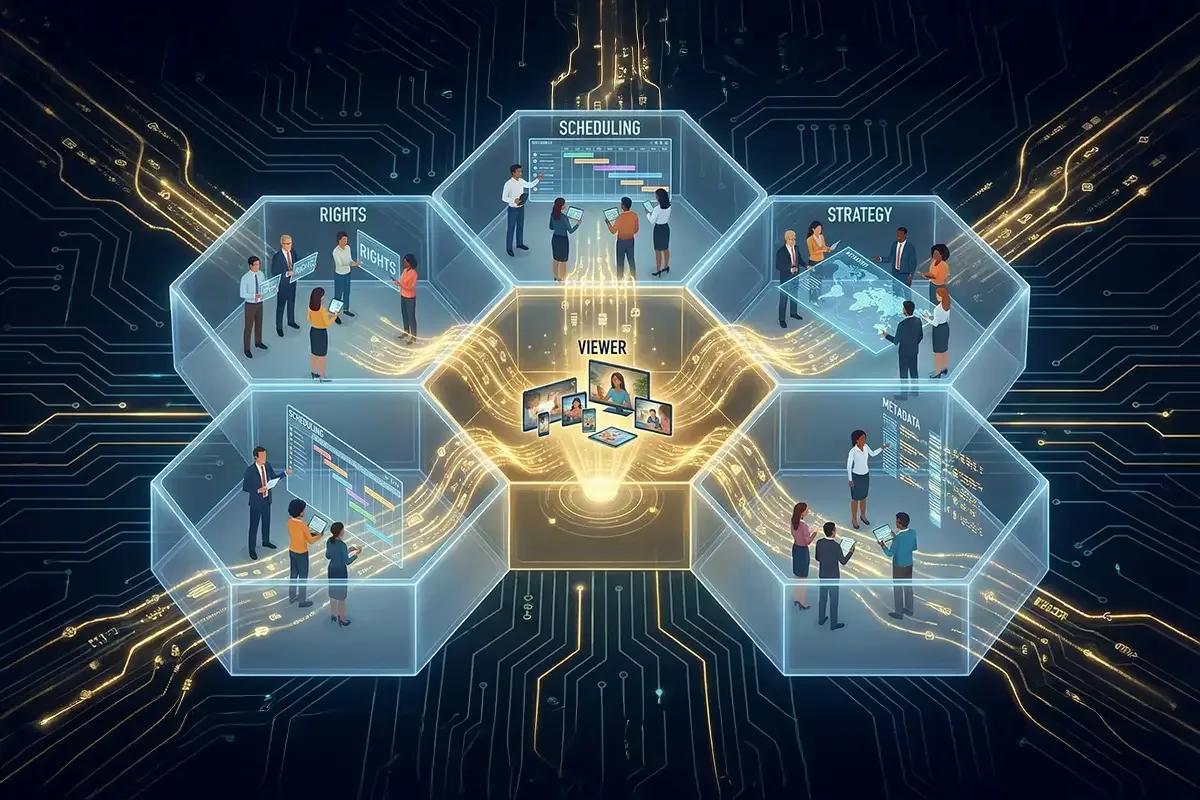
Inside a modern media organization, work doesn’t flow in a neat line. It’s more like a beehive:
- Someone is developing a strategy for a new genre.
- Someone else is building a lineup for next week.
- Another team is handling dubbing, compliance edits, or artwork.
- Others are managing rights renewals or planning new FAST channels.
All of this happens in parallel, not in sequence. The challenge (and the opportunity) is to equip everyone in that beehive with tools to learn real audience behaviour and, from those learnings, make smarter, faster decisions.
Its a real-time enterprise operation that drives an audience-centric operational model:
- Shared metadata across teams and systems.
- Transparent supply chains where status, costs, and performance are visible.
- Rights-aware automation that prevents costly mistakes and accelerates usage.
- Dynamic windowing and flexible scheduling that respond to actual demand.
- Unified operational data that feeds both top-down strategy and day-to-day decisions, giving every team a shared, real-time view of the entire content lifecycle.
The goal is simple to describe yet hard to implement: deliver the right content to the right audience at the right moment… automatically and at scale. This is what we are doing at Mediagenix.
Mediagenix as the Enabler of the Audience-Centric Future
Our industry is operating in an environment of refactoring. Consolidation, spin-offs, and mergers reshape portfolios. No one gets to build in a greenfield. For vendors, being nimble, open, and ecosystem-aware is a must. And while the broader industry is cheering on interoperability, there’s a very real crawl → walk → run progression to be able to mine the data in a way that helps you understand audience behaviour and supply chain bottlenecks. Rights, metadata, scheduling, and live viewing data live in different spaces; you need to elegantly integrate them.
Equally as important, without “homogenizing” the data, clean and standardize it. Otherwise, using emerging AI capabilities just amplifies the mess.
This is precisely the space where Mediagenix is positioning itself: as the connective tissue of the audience-focused supply chain.
Conceptually, think of Mediagenix as:
- A unified backbone for content planning, rights, scheduling, and distribution, rather than isolated point tools.
- A metadata-rich orchestration layer designed for multi-format, multi-platform delivery from day one.
- A system that improves discoverability, versioning, and multi-market agility, not just linear efficiency.
- A partner that reduces operational friction, instead of adding another island of complexity.
The acquisition of Spideo was a clear signal of our intent: Mediagenix isn’t just managing workflows, it’s investing in smart content discovery and audience-centric curation: the data and intelligence needed to power that monetization flywheel. We are moving the content supply chain from a back-office necessity to a strategic lever for growth, personalization, and adaptability.
Mediagenix is your partner for building your digital backbone, driving best-in-class audience-centric, data-driven, and smartly curated operations.
Contact us to learn more about turning your content supply chain into an audience-centric, revenue-generating operation in 2026.
Insights
Get inspired
09 Sep. 2026
Mediagenix Curation Unlocks Greater Catalog Value Through Personalized Audience Experiences
08 Sep. 2026
Mediagenix Personalization Curates Sports Content Around Individual Viewer Interests.

06 Aug. 2026
Mediagenix Helps Broadcasters Prepare for Brazil's DTV+ (TV 3.0) Future at SET Expo